
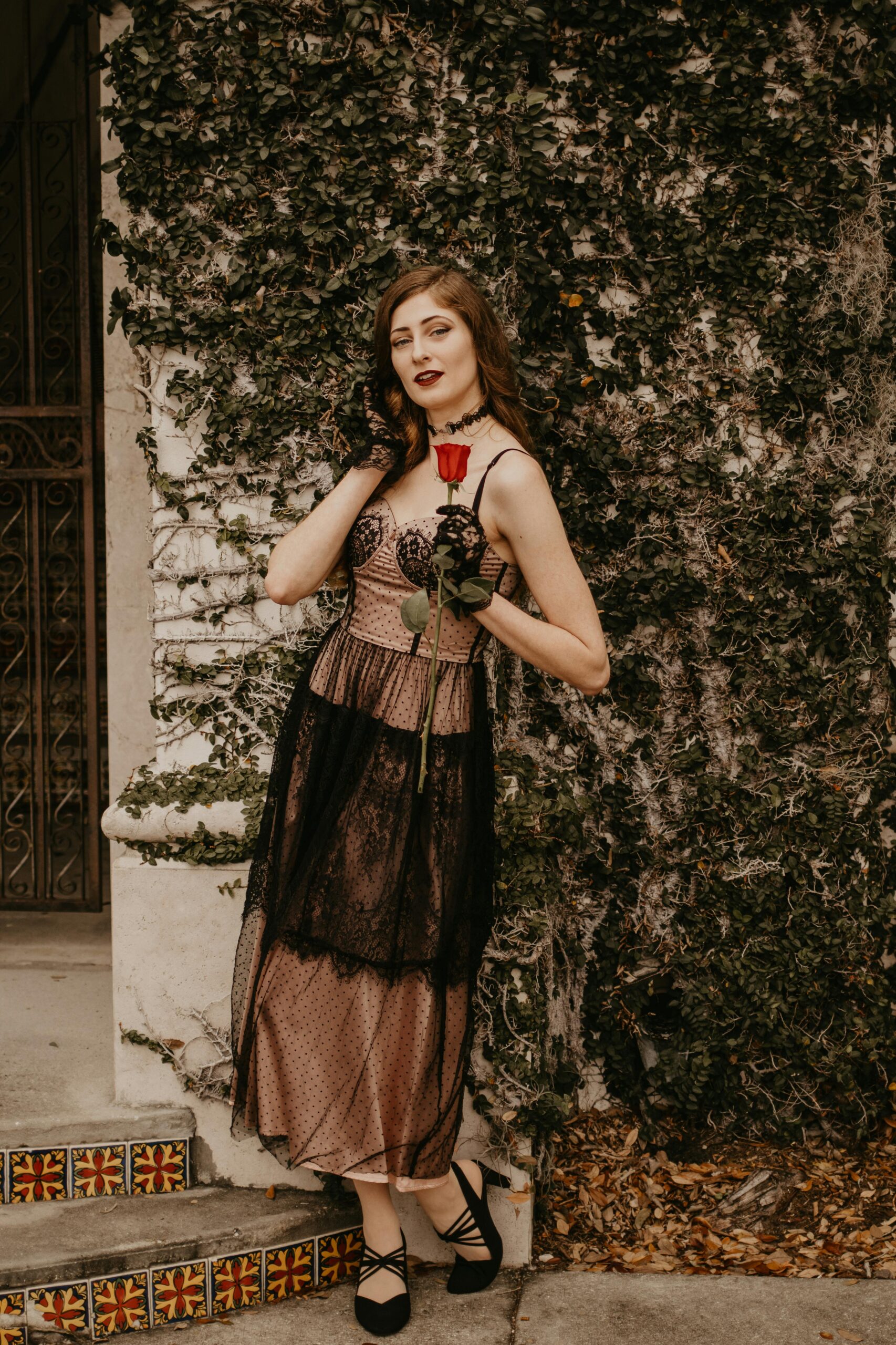
The Return of Romance: When Fashion Begins to Dream Again
In the era of speed, minimalism, and digital noise, fashion—ever cyclical, ever rebellious—has turned down the volume. No longer chasing only what’s sleek or utilitarian, the industry has stopped, exhaled, and dared to dream again. The result? A return to romance—not the sentimental cliché, but the sublime. A delicate, whisper-soft rebellion expressed in layers of tulle, blush tones, ruffles that float like memories, and silhouettes that don’t shout, but sing.
The runways of Spring/Summer and Fall 2025 have become a canvas of lightness. Designers are no longer chasing the future in metallics and sharp tailoring alone—they’re reaching inward, into nostalgia, poetry, and beauty for beauty’s sake. It’s a collective sigh of aesthetic relief: soft, emotional, and exquisitely crafted.
At Simone Rocha, fantasy meets fearlessness. Her collections walk the line between doll-like fragility and sculptural strength. Rose-embellished bodices, sheer puff sleeves, and cascading organza speak not to girlishness, but to a woman who wears softness like armor. There is power in choosing vulnerability, and Rocha knows it intimately.
Cecilie Bahnsen, the Danish designer beloved for her almost weightless creations, has carved a niche where craftsmanship and romance meet. Her dresses are more than garments—they are modern heirlooms. Quilted silks, cloud-like layers, and hand-finished textures evoke a Nordic fairytale that’s not about escaping the world, but dressing to face it with grace.
Even traditionally bold houses have caught the breeze. Valentino, under the poetic direction of Pierpaolo Piccioli, continues to redefine femininity not as fragility, but as bold softness. His gowns flow like sonnets, in barely-there shades of rose, ivory, and dusty lavender, embroidered with florals that seem almost alive. Similarly, at Elie Saab, ethereal eveningwear takes center stage—sequin-dusted, embroidered, and meant for women who want to glow, not glitter.
This return to romantic dressing isn’t a nostalgic nod to the past, nor is it a denial of the present. It’s a reclamation. For years, the word romantic was too often equated with being passive or fragile. Today, it’s being reframed. Romanticism, in its new form, is assertive. It’s purposeful. It’s about choosing the emotional over the purely practical. It’s softness worn with confidence, not compromise.
The silhouettes are telling: empire waists that echo Jane Austen heroines reimagined for the now; sheer overlays that offer both mystery and exposure; floral appliqués that feel freshly picked from a dream. And in this season’s palette—pastels with a pulse, creams with depth, rose tones that flirt with dusk—we find an emotional spectrum far more complex than a trend.
Off the runway, the aesthetic is blooming too. Social media, once dominated by streetwear and normcore, is slowly filling with lace collars, vintage slips, and voluminous skirts paired unexpectedly with boots or leather jackets. Romanticism today is less about a total look and more about an emotion—a detail, a softness, a gesture.
Because in a world that often rewards sharpness and speed, to dress with tenderness is a radical act. To wear something simply because it’s beautiful is not naive—it’s knowing. It’s choosing to pause, to feel, to express.
And perhaps, that’s the future of fashion: not louder, faster, edgier. But softer. Slower. More human.
Romance, it seems, is not only back. It never left—it just waited for us to be ready to feel it again.